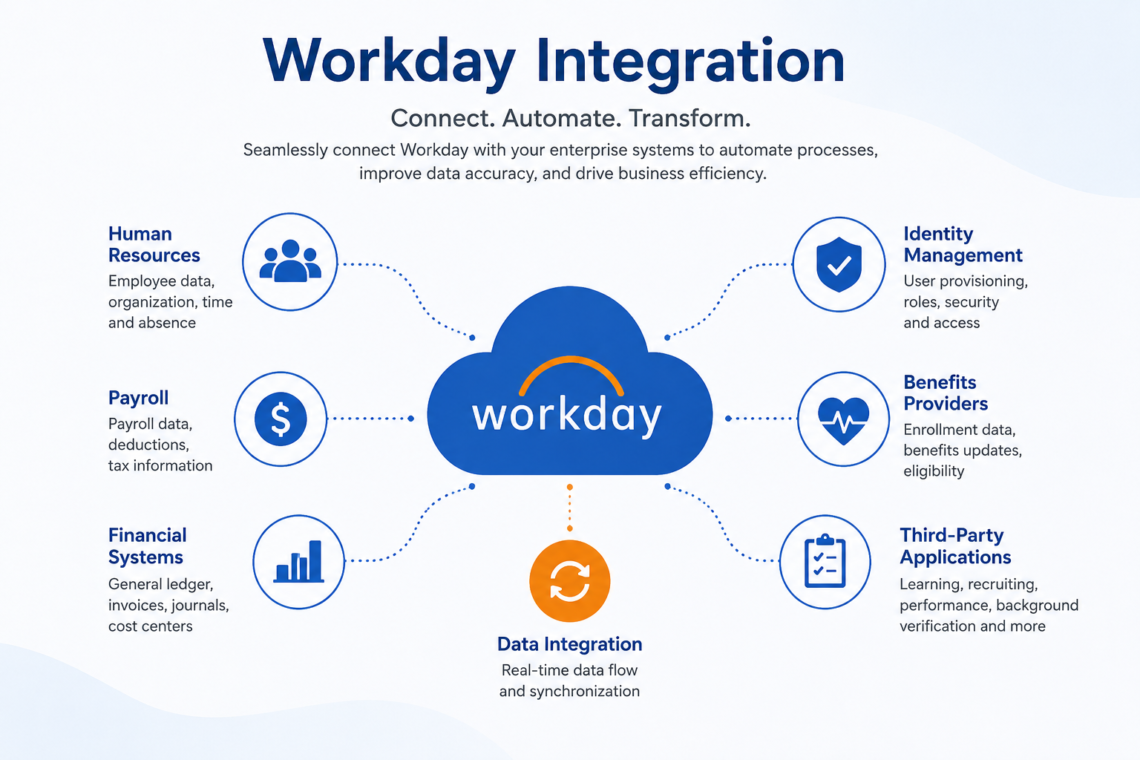
Workday Integration plays a very important role in helping organizations connect Workday with other business systems. Many companies use Workday for Human Capital Management, Payroll, Finance, Benefits, Recruiting, Time Tracking, Absence Management, and Talent Management. However, Workday often needs to exchange data with external applications such as payroll vendors, benefits providers, finance systems, identity management platforms, background verification tools, and third-party reporting systems. This is where Workday Integration becomes essential.
Workday Integration is the process of connecting Workday with internal or external systems so that data can flow securely and accurately between applications. Instead of manually entering employee, payroll, benefits, or financial data into multiple systems, organizations can use Workday integrations to automate data movement. This improves accuracy, reduces manual work, saves time, and supports better business operations.
There are different types of Workday integrations. One of the most commonly used integration tools is Enterprise Interface Builder, also known as EIB. EIB is used for both inbound and outbound integrations. An inbound EIB helps load data into Workday, such as employee updates, compensation changes, or time off data. An outbound EIB helps extract data from Workday and send it to another system, such as a payroll provider or benefits vendor.
Another important integration type is Core Connector. Core Connectors are prebuilt Workday integration templates used for common business needs. They are often used for worker data, payroll data, benefits data, and organizational information. These connectors reduce development effort and help organizations follow standard integration patterns.
For complex business requirements, organizations may use Workday Studio. Workday Studio is a powerful integration development tool used when advanced transformation, validation, custom logic, and multiple system connections are required. It is commonly used when standard EIB or Core Connector functionality is not enough.
Workday also supports integrations through APIs and web services. These are useful when organizations need real-time or near real-time data exchange between Workday and another application. API-based integrations are often used for identity management, finance platforms, recruiting tools, learning systems, and custom business applications.
Workday integrations provide many benefits. They improve data accuracy, reduce duplicate entry, support automation, improve compliance, and help teams make faster decisions. For example, a Workday payroll integration can send employee compensation, time tracking, and deduction data to a payroll system. A benefits integration can send employee enrollment information to insurance carriers. An identity integration can automatically create or update user access when an employee is hired, transferred, or terminated.
Security is also very important in Workday Integration. Since integrations often include sensitive employee and business data, organizations must use proper security groups, integration system users, authentication methods, and data access controls. A secure integration design helps protect confidential information and reduces compliance risk.
In conclusion, Workday Integration is a key part of any successful Workday ecosystem. It helps organizations automate business processes, connect systems, improve data quality, and reduce manual effort. Whether using EIB, Core Connectors, Workday Studio, APIs, or web services, a well-designed Workday integration strategy can help businesses get more value from their Workday investment.
